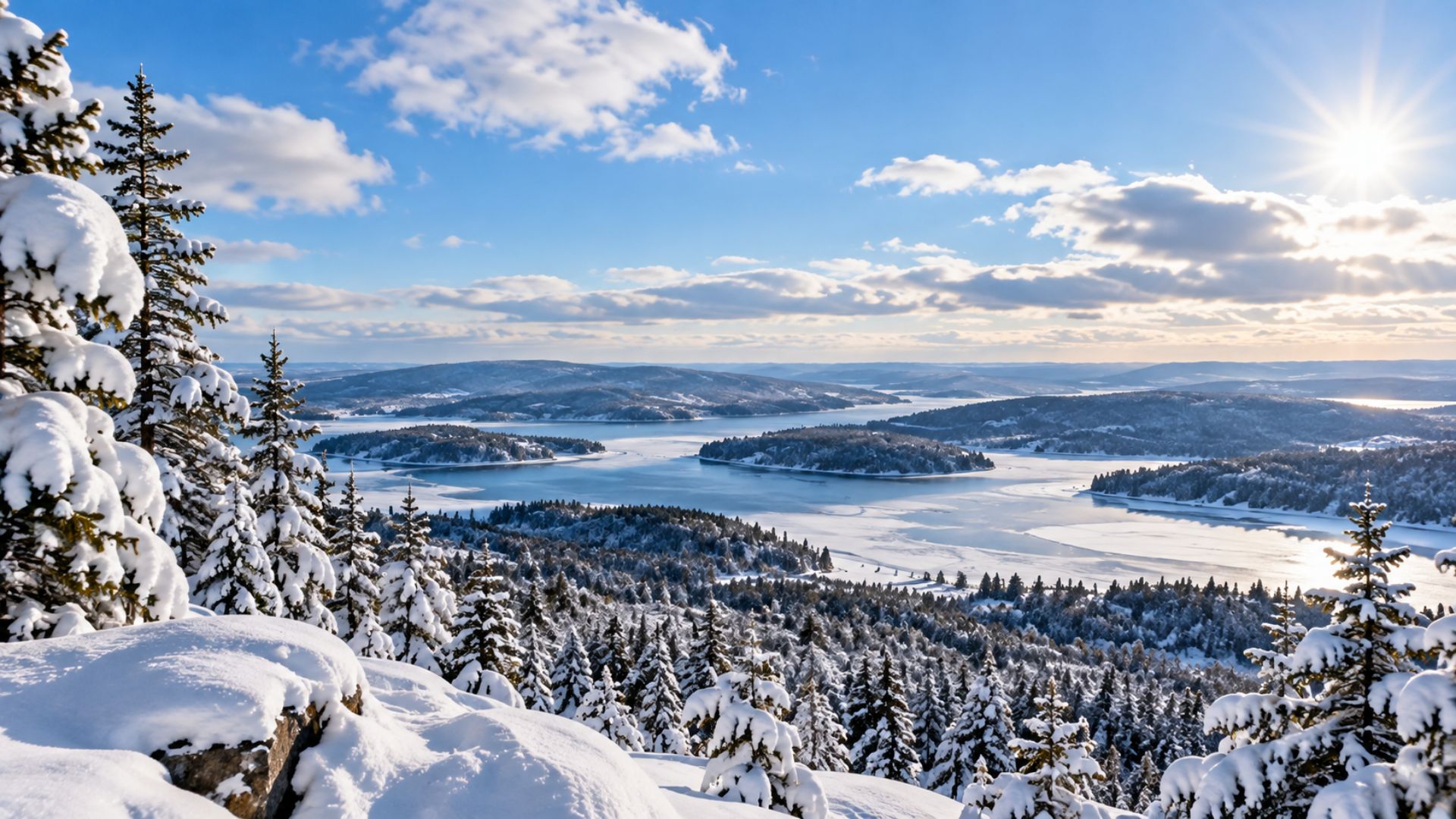

Some of Ontario’s snowiest communities can receive around 300 centimetres of snow or more over the course of an average year. The Georgian Bay snowbelt is particularly notable, with communities southeast and east of the bay frequently experiencing heavy bursts of snow when prevailing winds carry moisture inland.
Below are five of the snowiest places in Ontario, followed by a closer look at how much snow each location receives and the geographic and atmospheric factors that make these communities so snowy.
| Rank | Place | Region |
| 1 | Sault Ste. Marie | Algoma |
| 2 | Coldwater | Simcoe County |
| 3 | Orillia | Simcoe County |
| 4 | Minesing | Simcoe County |
| 5 | Flesherton | Grey County |
1. Sault Ste. Marie

Sault Ste. Marie is one of Ontario’s snowiest cities. Environment Canada’s 1971–2000 climate normals recorded an average annual snowfall of 302.9 cm, while figures based on the 1981–2010 climate normals put average annual snowfall at approximately 320.7 cm. In other words, a typical winter can bring roughly three metres of accumulated snowfall to the city.
Its location helps explain the high totals. Sault Ste. Marie sits near the eastern end of Lake Superior, where cold air travelling across the lake can collect heat and moisture before reaching land. When conditions are favourable, this produces lake-effect snow and localized snow squalls. The city’s northern location also provides a long season in which precipitation can fall as snow. Environment Canada’s historical normals show substantial average snowfall in both December and January, demonstrating how persistent the snowy season can be.
2. Coldwater

Coldwater is located in Simcoe County within one of Southern Ontario’s best-known snowbelt regions. The community is close to Georgian Bay and can receive roughly 300 cm or more of snow during a snowy year, although the exact long-term average depends on the weather station and climate period being used.
Georgian Bay is the primary reason the Coldwater area experiences so much snow. During late fall and winter, cold northwesterly winds can travel across the comparatively warmer waters of Georgian Bay, absorb moisture and carry it inland. As that moist air reaches the colder land east and southeast of the bay, narrow but intense bands of lake-effect snow can develop. Because these bands can repeatedly affect the same area, snowfall can accumulate rapidly even when communities farther away receive relatively little snow.
3. Orillia

Orillia is another notably snowy community in Central Ontario. The city generally receives well over 200 cm of snow in an average year, with seasonal totals capable of climbing substantially higher during winters with frequent lake-effect events.
Orillia sits between Lake Simcoe and Georgian Bay, placing it close to the eastern edge of Ontario’s Georgian Bay snowbelt. Georgian Bay is the more important source of major lake-effect snowfall. Cold west and northwest winds crossing the bay can generate organized snow bands that travel inland toward Simcoe County. Depending on wind direction, these bands can affect Orillia and surrounding communities for hours at a time. The result is a winter climate characterized not only by frequent snowfall but also by occasional periods of very heavy snow and sharply reduced visibility.
4. Minesing

Minesing is a small Simcoe County community west of Barrie and close to the Minesing Wetlands. Its position southeast of Georgian Bay puts it directly within a region that can experience some of Southern Ontario’s most persistent lake-effect snowfall. The broader area can receive roughly 250 to 300 cm of snow in a typical snowy season, with totals varying significantly from one winter and measuring location to another.
Minesing’s proximity to Georgian Bay is central to its snowfall. Northwesterly winds provide a long stretch of open water over which cold air can gain moisture before reaching Simcoe County. Once inland, that moisture can fall in concentrated snow squalls. Lake-effect snow is highly localized, so snowfall around Minesing can sometimes be dramatically different from totals only a relatively short distance away. Repeated snow squalls throughout the season contribute to the area’s high overall snowfall.
5. Flesherton

Flesherton, located in Grey County, is part of another exceptionally snowy section of the Georgian Bay snowbelt. The community and surrounding higher terrain can receive around 250 to 300 cm or more of snow during a typical winter, although annual totals vary depending on the climate station and frequency of lake-effect events.
Flesherton benefits from two ingredients that favour heavy snow: proximity to Georgian Bay and elevation. Cold air crossing Georgian Bay can produce lake-effect snow before moving inland toward Grey County. As the moist air encounters the higher terrain of the region, it is forced upward, which can enhance cooling, condensation and snowfall. This combination helps make the higher elevations of Grey County some of the snowiest parts of Southern Ontario.
Why Are These Parts of Ontario So Snowy?
The Great Lakes are responsible for much of the geographic difference in snowfall across Ontario. During late fall and winter, very cold air frequently moves across unfrozen sections of Lake Superior, Lake Huron and Georgian Bay. The air gains heat and moisture from the water below before moving back over land, where that moisture can condense into clouds and fall as lake-effect snow.
Wind direction determines which communities receive the heaviest snow. A narrow snow squall may produce intense snowfall over one community while another location only tens of kilometres away sees considerably less. Elevation and local terrain can further enhance snowfall after these bands move inland.