

Our Verdict
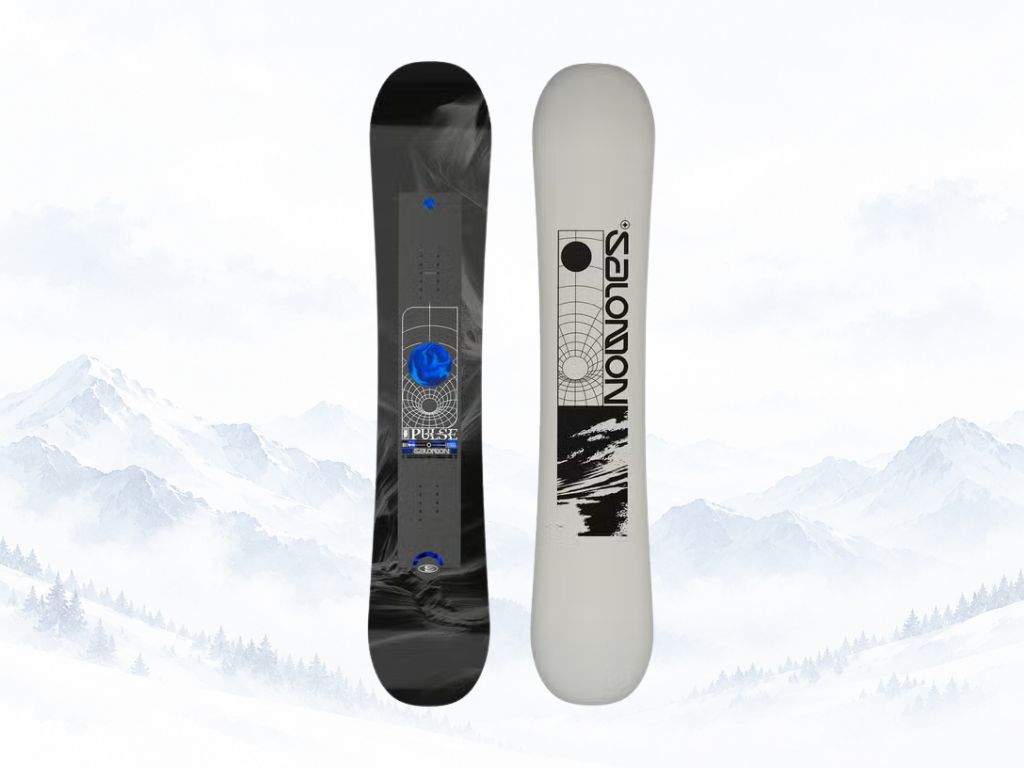
The 2027 Salomon Pulse is an entry-level all-mountain snowboard designed for beginners and progressing intermediate riders. Its soft flex, directional twin shape, and forgiving edge construction make it particularly appealing to snowboarders who want to build confidence without fighting an overly aggressive board.
At $399.95 CAD, the Pulse offers an accessible combination of practical features and beginner-friendly performance. It’s best suited to groomed runs, learning turns, and exploring basic freestyle riding rather than high-speed carving or demanding mountain terrain.
Pros & Cons
- Soft, forgiving flex makes turning and controlling the board easier for beginners.
- Flat Out Camber and Bite Free Edges help reduce unwanted edge catches.
- Affordable price and low-maintenance extruded base provide good value.
- Soft construction offers limited support for aggressive, high-speed riding.
| Specification | Details |
|---|---|
| Brand | Salomon |
| Model | Pulse (2027) |
| Type | All-Mountain / Freestyle |
| Riding Level | Beginner to Intermediate |
| Profile | Flat Out Camber |
| Shape | Directional Twin |
| Flex | Soft |
| Core | Aspen with Popster construction |
| Fiberglass | BIAX MD |
| Base | Extruded |
| Edge Technology | Bite Free Edges |
| Mounting System | 4×2 Inserts |
| Available Sizes | 142, 145, 149, 152, 156, 158W, 160, 162W, 163 cm |
| Retail Price | $399.95 CAD |
Design, Features and Performance
The Salomon Pulse focuses on making snowboarding approachable. Rather than emphasizing maximum stiffness, carving power, or high-speed stability, its construction prioritizes easy turn initiation, predictable handling, and a forgiving feel.
For beginners learning to link turns and intermediate riders developing their technique, these characteristics are particularly valuable.
Flat Out Camber and Edge Control
One of the Pulse’s defining features is Salomon’s Flat Out Camber profile. This design combines flatter sections of the board with camber beneath the rider’s feet, providing a balance between stability and forgiveness.
Compared with a more aggressive traditional camber snowboard, this profile should make the Pulse easier to manage at slower speeds. It provides enough response for developing edge control without requiring the same level of precision as a performance-oriented board.
Salomon also incorporates Bite Free Edges, which are detuned to reduce unwanted edge catches. This is particularly useful for beginners who are still learning to transition between their heel and toe edges.
However, the same forgiving edge treatment limits the board’s appeal for aggressive carving. Riders who regularly encounter hard-packed or icy conditions may prefer a snowboard with more pronounced edge engagement.
Flex and Core Construction
The Pulse features a soft flex that makes it easier to bend, steer, and manoeuvre than a stiffer all-mountain snowboard.
Its Aspen wood core provides the foundation for a lightweight, responsive construction, while Salomon’s Popster profiling is designed to improve natural flex and energy transfer through the nose and tail.
BIAX MD fiberglass reinforces the board while maintaining a relatively approachable feel.
Together, these features create a snowboard that favours control and manoeuvrability over maximum power. The softer construction can also make learning basic presses, ollies, and freestyle movements more accessible.
The trade-off is reduced support for aggressive riding. Stronger riders may find that the board lacks the stiffness needed for powerful turns, larger jumps, and sustained high-speed performance.
Speed and Stability
The Salomon Pulse is better suited to comfortable, controlled riding than pushing maximum speeds.
Its Flat Out Camber profile provides some stability underfoot, while its directional twin shape offers a familiar platform for exploring different types of terrain.
On groomed beginner and intermediate runs, these features should provide the predictable handling that progressing snowboarders need.
However, the board’s soft flex can become a limitation as speeds increase. Compared with stiffer alternatives, it is likely to offer less support when charging through uneven snow or making aggressive turns.
For riders who prioritize carving precision and high-speed stability, a medium-flex all-mountain snowboard would generally be a more suitable investment.
Base and Durability
Salomon equips the Pulse with an extruded base, a practical choice for an entry-level snowboard.
Extruded bases are generally easier to repair and require less maintenance than high-performance sintered alternatives. This makes them appealing to beginners who may encounter occasional scratches and damage while learning.
The trade-off is glide performance. A well-maintained sintered base will typically offer greater speed potential, particularly for experienced riders who regularly wax and maintain their equipment.
The Pulse also includes ABS sidewalls, a standard stone finish, and a 4×2 binding insert system.
Overall, its construction emphasizes practicality and value rather than premium performance materials.
Powder and Freestyle Performance
Although the Salomon Pulse is classified as an all-mountain snowboard, its strongest applications are groomed terrain and introductory freestyle riding.
Its directional twin shape provides a relatively symmetrical platform for learning switch riding and basic park skills. The soft flex also makes smaller jumps, presses, and other introductory tricks more approachable.
However, it isn’t a dedicated park snowboard. Riders who eventually prioritize larger jumps and more technical freestyle features may want something with greater stability and responsiveness.
In powder, the Pulse’s slightly directional design offers some assistance, but it lacks the specialized geometry of a dedicated freeride or powder board.
Riders who spend considerable time in deep snow will likely benefit from a snowboard designed specifically for flotation.
Who Should Buy the Salomon Pulse?
The Salomon Pulse is best suited to beginners purchasing their first snowboard and intermediate riders who prefer a forgiving, easy-to-control setup.
It’s particularly appealing to snowboarders who spend most of their time on groomed resort runs, learning to link turns, improving edge control, and occasionally experimenting with basic freestyle tricks.
Its relatively affordable price also makes it attractive to riders who want to purchase their own equipment without committing to an expensive, performance-oriented snowboard.
However, the Pulse isn’t the best choice for everyone.
Experienced riders who enjoy aggressive carving, high speeds, and challenging terrain will likely find its soft flex limiting. Similarly, snowboarders who regularly ride deep powder or advanced freestyle terrain should consider more specialized alternatives.
The Pulse makes the most sense for someone who values an approachable learning experience over maximum performance.
How Does the Salomon Pulse Compare to Alternatives?
Ride Agenda
The 2027 Ride Agenda is another affordable snowboard designed for beginner and intermediate riders.
Like the Pulse, it features a softer flex and a progression-focused design. However, the Agenda uses Ride’s Standard Camber profile, combining camber between the bindings with rocker toward the tip and tail.
Its true twin shape also makes it particularly appealing to riders who want to explore park riding and develop their switch skills.
The Pulse is the better fit for someone who prioritizes forgiving edge behaviour and easy progression, while the Agenda may appeal more to riders seeking an all-mountain snowboard with a stronger freestyle emphasis.
Salomon Sight
The Salomon Sight is another alternative worth considering, particularly for riders interested in developing their all-mountain and freeride skills.
Unlike the Pulse’s directional twin construction, the Sight uses a more directional shape and Cross Profile camber to support turning and flotation.
This makes it a more appealing option for riders who want to explore varied terrain and develop beyond beginner-friendly groomed runs.
The Pulse remains the more straightforward choice for riders primarily concerned with learning basic techniques and maintaining an easygoing, forgiving feel.
Final Verdict: Is the Salomon Pulse Worth It?
The 2027 Salomon Pulse is a strong option for beginners and progressing intermediate snowboarders who want an affordable, forgiving board.
Its soft flex, Flat Out Camber profile, and Bite Free Edges make it well suited to developing fundamental skills without the demanding characteristics of a more aggressive snowboard. The extruded base and practical construction also help keep maintenance relatively straightforward.
At $399.95 CAD, it offers good value for riders who prioritize learning and casual all-mountain performance.
However, its limitations become more noticeable as riding ability increases. The soft construction and forgiving edges make it less suitable for high-speed carving, technical terrain, and aggressive freestyle riding.
For someone purchasing their first snowboard or upgrading from rental equipment, the Pulse deserves serious consideration. More experienced riders should look for a board that better matches their performance expectations.
Snowstorms Rating: 4.4/5
An affordable, forgiving snowboard that makes sense for beginners, with enough versatility for developing intermediate riders.